

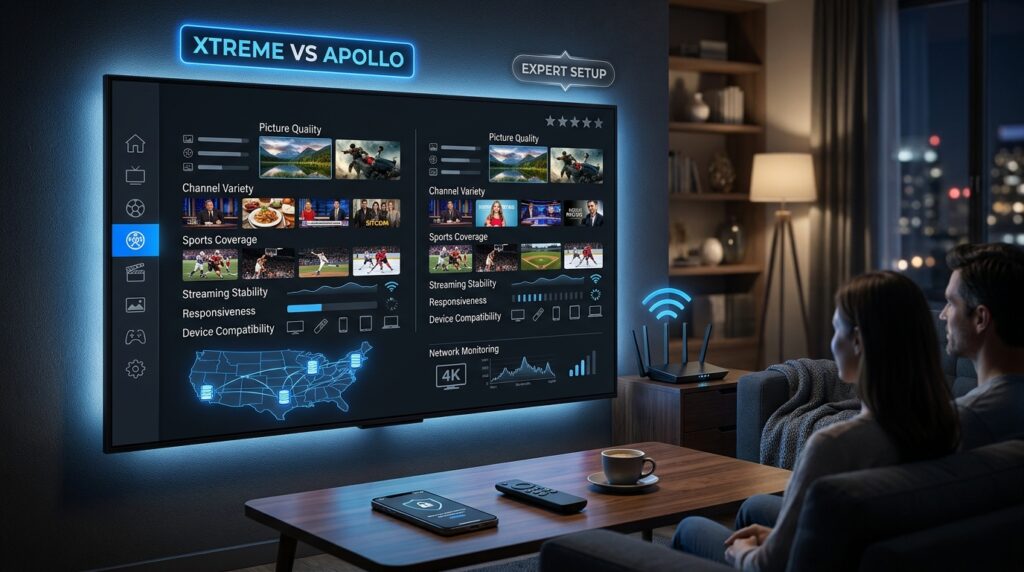
Understanding the Xtreme HD IPTV vs Apollo TV Architecture
To make an informed purchasing decision in today’s digital market, you must first understand the underlying engineering that powers modern video distribution. Legacy cable relies on an aging grid of physical coaxial lines that push radio frequencies into a rented, power-hungry set-top box.
Internet Protocol Television fundamentally disrupts this physical limitation. Instead of relying on dedicated coaxial wiring, live broadcast feeds are encoded into compressed data packets and transmitted across high-speed fiber networks. For a deep technical overview of how this packet routing operates globally, you can review the Wikipedia entry on Internet Protocol Television.
Consequently, any serious xtreme hd iptv vs apollo tv comparison must analyze how these platforms connect your home theater directly to a localized, high-capacity architectural backbone. The physical geographic location of the streaming server dictates whether your picture remains razor-sharp or degrades into a pixelated mess when viewership traffic spikes.
Domestic Data Centers vs. Offshore Routing
Server latency is your biggest adversary when streaming live, uncompressed television. If you are watching a live NBA playoff game in Chicago, but your streaming provider’s primary ingestion server is located thousands of miles away in Eastern Europe, your data packets must cross the Atlantic Ocean before reaching your screen.
That geographic bottleneck causes severe broadcast delays, desynchronized audio tracks, and relentless buffering loops. In the xtreme hd iptv vs apollo tv evaluation, the victor is the network that eliminates this bottleneck entirely by deploying localized Content Delivery Networks (CDNs) housed strictly within major American data hubs like Ashburn, Dallas, New York, and Los Angeles. When you stream through an enterprise domestic network, video packets travel along localized fiber routes and arrive at your television in milliseconds.
The Financial Reality of the Xtreme HD IPTV vs Apollo TV Debate
The primary catalyst driving millions of households to research the xtreme hd iptv vs apollo tv debate is the undeniable financial relief of cutting the cord. Traditional cable conglomerates are notorious for advertising attractive introductory rates that quietly double after your first twelve months under contract.
When you audit a standard monthly cable statement alongside modern digital alternatives, the predatory billing practices driving consumers away become glaringly obvious. In 2026, migrating your household entertainment to a premium streaming setup saves the average family well over $1,500 every single year.
| Monthly Expense Category | Traditional US Cable Carrier | Elite USA Streaming Network |
| Base Programming Package | $90.00 – $125.00 / mo | $10.00 – $15.00 / mo |
| Broadcast TV Surcharge | $18.00 – $25.00 / mo | $0.00 (Included) |
| Regional Sports Network Fee | $14.00 – $18.00 / mo | $0.00 (Included) |
| HD Set-Top Box Rentals (2 TVs) | $20.00 – $30.00 / mo | $0.00 (Bring Your Own Device) |
| 4K VOD & PPV Event Access | $50.00 – $79.99 per event | $0.00 (Included) |
| Estimated Annual Cost | $1,704.00 – $2,376.00+ | $70.00 – $120.00 |
Eliminating Mandatory Surcharges
Legacy cable operators deliberately pad their monthly invoices with mandatory surcharges that drastically inflate your true out-of-pocket cost. These unavoidable junk fees drain hundreds of dollars from your bank account annually:
-
Broadcast TV Fees: A mandatory $18 to $25 monthly charge just to receive over-the-air local stations like ABC, CBS, NBC, and FOX.
-
Regional Sports Surcharges: Billed automatically to every subscriber in a market, even if no one in your home watches local baseball, basketball, or hockey.
-
Hardware Rental Fees: Recurring $10 to $15 monthly charges for every outdated, refurbished set-top box placed in your living room.
A major selling point in the xtreme hd iptv vs apollo tv conversation is complete pricing transparency. Because modern digital broadcasting is entirely software-driven, you stream directly on the smart hardware you already own, wiping out equipment rental fees permanently.
Core Features in the Xtreme HD IPTV vs Apollo TV Showdown
Navigating the crowded digital streaming market requires strict technical evaluation criteria. A premier domestic operator will always prioritize viewer freedom, server uptime, and comprehensive regional programming.
Before committing your entertainment budget, you must verify that several core broadcasting capabilities are included. When comparing xtreme hd iptv vs apollo tv, only the service backed by enterprise domestic infrastructure can deliver a true Ultra HD experience consistently.
Hometown Affiliates and Live PPV
One of the biggest frustrations for American sports fans is localized broadcast blackouts. Legacy cable and satellite carriers routinely enter contract disputes with regional sports networks (RSNs), leaving loyal fans unable to watch their hometown MLB, NBA, or NHL teams during crucial playoff stretches.
Evaluating the xtreme hd iptv vs apollo tv options requires inspecting the directory of local affiliates and regional sports channels. Elite platforms bypass local blackout restrictions entirely, aggregating every major American sports network, hometown news affiliate, and live pay-per-view fight card into one cohesive interface. To see how a properly structured domestic channel directory is organized, browse our comprehensive channels list.
Multi-Terabyte 4K Video-On-Demand (VOD) Libraries
Beyond live linear television, a complete home entertainment hub requires a deep Video-On-Demand library. Resolving the xtreme hd iptv vs apollo tv debate means finding a package that effectively replaces the need to juggle five or six separate streaming apps like Netflix, Hulu, Max, Apple TV+, and Paramount+.
Leading platforms maintain multi-terabyte VOD servers that are updated weekly with the latest theatrical releases and binge-worthy television series. You should expect true 1080p and 2160p (4K) video bitrates, multi-language closed captioning, and 5.1 Dolby Digital surround sound audio tracks.
Home Network Requirements for Xtreme HD IPTV vs Apollo TV
One of the most frequent mistakes new cord-cutters make is blaming their streaming host for video stuttering that is actually caused by a congested local home network. Decoding live, uncompressed 4K video streams requires steady, uninterrupted bandwidth.
The reality uncovered in any xtreme hd iptv vs apollo tv test is that even the most advanced network cannot compensate for a weak home Wi-Fi router that drops data packets before they ever reach your television screen.
FCC Bandwidth Benchmarks for Ultra HD
According to federal telecommunications guidelines, specific dedicated download speeds are necessary to maintain smooth video playback across multiple household screens. You can review the official FCC Broadband Speed Guide for detailed data consumption metrics across modern connected homes.
To ensure your living room setup runs without a hitch, your internet connection should satisfy these baseline speed thresholds per active television:
-
Standard Definition (480p): 5 Mbps dedicated download speed.
-
Full High Definition (1080p at 60fps): 15 Mbps dedicated download speed.
-
Ultra High Definition (4K / 2160p): 30 Mbps or higher dedicated download speed.
Wi-Fi 6E Optimization vs. Hardwired Ethernet
Relying on a cheap, ISP-supplied wireless router tucked inside a media cabinet is rarely sufficient for high-bitrate live broadcasts. To ensure feeds analyzed in the xtreme hd iptv vs apollo tv debate maintain rock-solid stability, implement these three home networking upgrades:
-
Hardwire via Ethernet: Running a Cat6 Ethernet cable directly from your router to your streaming device is the single most effective way to eliminate wireless interference and packet loss.
-
Lock Onto the 5GHz or 6GHz Band: If running a physical cable is impractical, connect your streaming stick exclusively to your router’s 5GHz (or Wi-Fi 6E) band rather than the crowded, slower 2.4GHz frequency.
-
Audit Real-Time Connection Speeds: Run a live diagnostic check using Speedtest by Ookla directly next to your television set prior to kickoff to verify your local throughput and ping.
Hardware Compatibility for Xtreme HD IPTV vs Apollo TV
When transitioning away from cable, hardware flexibility is vital. You should never allow a vendor to force you into buying an overpriced, locked-down proprietary box just to access their channel lineup.
Fortunately, a platform worthy of winning the xtreme hd iptv vs apollo tv comparison gives you total hardware independence. Top services support an open software ecosystem, allowing you to install your preferred media player across any smart device in your home.
Best Streaming Devices for US Homes
-
Nvidia Shield TV Pro: The undisputed powerhouse for home theater enthusiasts. Its Tegra processor effortlessly decodes heavy 4K HEVC streams and uses AI upscaling to sharpen 720p and 1080p sports broadcasts in real time.
-
Amazon Fire TV Stick 4K Max: The most popular plug-and-play streaming stick in America thanks to its budget-friendly price tag, Wi-Fi 6E support, and straightforward app sideloading.
-
Apple TV 4K (3rd Gen): A lightning-fast, ad-free hardware platform that pairs seamlessly with native tvOS players like UHF and GSE Smart IPTV, rendering massive Electronic Program Guides (EPGs) with zero lag.
By choosing an open-platform service, you can pair the credentials discussed in this xtreme hd iptv vs apollo tv guide with industry-leading players like TiviMate or IPTV Smarters Pro in minutes. If you want to learn more about our multi-device engineering and server compatibility, visit the IPTV Verse about us page.
Why the Xtream Codes API Outperforms Legacy M3U
Years ago, streaming users had to manually input lengthy M3U text URLs to load their channel lists. Because modern lineups contain tens of thousands of live channels and VOD titles, raw M3U files frequently overload the internal memory of compact streaming sticks and break scheduled DVR recordings.
A platform winning the xtreme hd iptv vs apollo tv debate utilizes the Xtream Codes API protocol as its primary connection standard. This API establishes a direct, encrypted handshake between your media player and the provider’s server database. Instead of forcing your Firestick to download a massive text file all at once, the API dynamically fetches channel categories and EPG time slots on demand.
Digital Privacy When Testing Xtreme HD IPTV vs Apollo TV
When migrating your household’s daily entertainment to the open internet, protecting your digital footprint is essential. Using third-party media player applications to decode internet video streams on your personal hardware is standard practice for millions of consumers.
At the same time, the regulatory landscape governing digital media distribution and intellectual property in North America is strict. To better understand federal copyright frameworks, you can consult the official U.S. Copyright Office website.
Defeating ISP Throttling
Major American Internet Service Providers (such as Comcast Xfinity, Spectrum, and AT&T) actively monitor residential data traffic patterns. When your ISP detects continuous, high-bandwidth video packets flowing to your home during prime-time Sunday night football, their automated traffic-shaping algorithms may intentionally throttle your connection speed.
To bypass ISP throttling, experts conducting an xtreme hd iptv vs apollo tv review strongly advise running a reputable Virtual Private Network (VPN) directly on your streaming device. A VPN wraps your data packets in an encrypted tunnel, preventing your ISP from inspecting your video streams or artificially capping your speeds. For comprehensive educational guides on consumer internet privacy, visit the Electronic Frontier Foundation (EFF).
Customer Support Standards: Xtreme HD IPTV vs Apollo TV
When comparing different streaming platforms, most shoppers focus exclusively on channel counts and VOD totals. However, any seasoned cord-cutter conducting a personal xtreme hd iptv vs apollo tv test knows that responsive, human technical support is the true separating factor over a twelve-month contract.
Live internet broadcasting involves thousands of moving parts. Occasionally, a regional sports feed will require a manual transponder reset on the backend, or a new user will need help configuring their Xtream Codes API credentials on a brand-new Smart TV.
Immediate, knowledgeable technical assistance is what distinguishes a premier service from fly-by-night operations. When you sit down on a Saturday evening and need help configuring your EPG time offset, you need a provider that staffs live chat and direct WhatsApp support during American waking hours.
If a vendor only provides a generic contact form or an email ticketing queue that takes four business days to generate an automated reply, they do not deserve your business. To experience how responsive, 24/7 customer engineering support should function, contact our dedicated support team anytime.
How to Stress Test the Setup (Xtreme HD IPTV vs Apollo TV)
Before committing to a six-month or annual billing cycle with any digital platform, you should always put their server network through a real-world stress test on your own television. Never rely blindly on anonymous forum comments or a biased affiliate xtreme hd iptv vs apollo tv review.
When evaluating a platform to verify whether it truly ranks as an elite host, follow this three-step verification protocol:
-
Start with a Short Evaluation Window: Never hand over money for a full year upfront without testing the stream quality on your personal home network first.
-
Audit Prime-Time Sports Broadcasts: Tune into a high-profile live sporting event between 7:00 PM and 10:00 PM EST on a Saturday or Sunday night. This peak window reveals whether their domestic CDN load balancers can handle heavy concurrent viewer traffic without buffering.
-
Check EPG Accuracy and Channel Zapping: Flip rapidly between local news stations, national sports networks, and 4K movie channels to confirm that streams lock in under two seconds and program guide data matches your local US time zone.
To run your own real-world evaluation on an enterprise-grade domestic network that passes every peak-hour test effortlessly, claim your 24-hour trial today and experience the difference firsthand.
Frequently Asked Questions
Why are domestic servers crucial in an xtreme hd iptv vs apollo tv comparison?
Localized American servers eliminate transatlantic data latency. When a provider hosts their streams on domestic US server nodes rather than overseas European servers, video packets travel a fraction of the distance, preventing frame drops and buffering during high-traffic live sports events.
Will my live NFL or NBA streams buffer during peak weekend games?
Stream stability depends on two core variables: the server capacity of your provider and the throughput of your home network. When you activate a subscription that utilizes load-balanced domestic CDNs and maintain at least 30 Mbps of download speed via Ethernet, you can enjoy crystal-clear broadcasts without buffering.
Can I use my own third-party media player app?
Yes. An authentic provider winning the xtreme hd iptv vs apollo tv matchup will never lock you into a shady, ad-riddled proprietary app. They supply standard Xtream Codes API and M3U credentials so you can link your subscription seamlessly to trusted apps like TiviMate, IPTV Smarters Pro, or UHF on Apple TV.
Is it safe to purchase an annual subscription plan upfront?
Buying a 12-month package is the smartest way to lock in the lowest monthly rate, provided you conduct your own xtreme hd iptv vs apollo tv test first. Always test the platform using a 24-hour trial or a one-month plan to confirm server uptime, local channel availability, and support responsiveness before upgrading.
Do I need a brand-new Smart TV to use these streaming services?
Not at all. Any standard television with a working HDMI port can be transformed into a state-of-the-art streaming hub by plugging in an affordable external device like an Amazon Fire TV Stick 4K Max, an Apple TV 4K, or an Nvidia Shield Pro.
Final Verdict: Settling the Xtreme HD IPTV vs Apollo TV Debate
Cutting the cord and transitioning your household to internet-based television is the smartest financial and entertainment upgrade you can make in 2026. However, as proven throughout this xtreme hd iptv vs apollo tv breakdown, the quality of your daily viewing experience depends entirely on the server infrastructure powering your screen.
The modern American viewer demands zero-lag live sports, complete access to hometown news affiliates, a massive 4K movie catalog, and the freedom to use their favorite streaming hardware. Settling for an overcrowded offshore reseller just to save a couple of dollars a month only leads to frozen screens during the biggest games of the year.
The only way to guarantee a true cable-replacement experience is to invest in a verified connection operating on dedicated domestic infrastructure. By applying the principles detailed in this xtreme hd iptv vs apollo tv guide, prioritizing localized North American servers and open API compatibility, you secure flawless Ultra HD entertainment while keeping over a thousand dollars a year in your pocket.
Are you ready to leave overpriced cable contracts behind and connect your home theater to an enterprise-grade domestic network? To lock in crystal-clear 4K channels, uncensored regional sports, and instant activation, start your premium subscription today and transform your living room setup. If you need step-by-step assistance configuring your Firestick, Apple TV, or Smart TV, our technical specialists are standing by right now on WhatsApp at +212 642-212736 to provide fast, personalized support.