

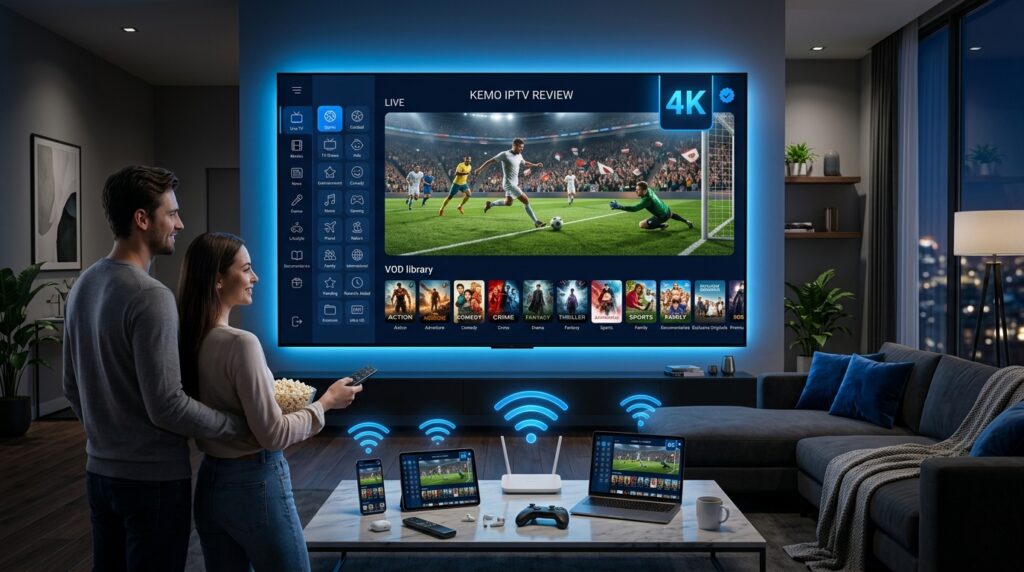
What This Kemo IPTV Review Covers
Kemo IPTV delivers television across your internet connection rather than a cable line or satellite dish. The Wikipedia entry on Internet Protocol Television explains the underlying mechanics for anyone curious.
The service markets itself broadly across North America, Europe, Africa, and the Middle East, sometimes under the Kemo Sat name in certain regions. Its natural audience includes:
- Cord-cutters wanting a large channel count at a low price
- International households, given its wide regional coverage
- Multi-device families needing several concurrent streams
- Firestick and Android users comfortable with player apps
This Kemo IPTV review works through what it delivers, then confronts the two issues that explain its polarised reputation.
Kemo IPTV Channels and Content
The advertised lineup covers extensive ground:
- Live channels across the USA, UK, Canada, Africa, the Middle East, Europe, and Asia
- Sports coverage including major leagues and events
- News, kids, lifestyle, and international programming
- A VOD library of films and series
- HD, Full HD, and select 4K streams, with EPG and Catch-Up TV
Reported channel counts in any Kemo IPTV review vary considerably, from 10,000 to over 21,000, with VOD claims spanning 8,000 to 40,000 titles. That spread reflects both genuine differences between sources and the marketing inflation common across the category. Treat any single figure as unverified until you see it yourself.
Compare that against our openly itemised full IPTV channels list, where the count means precisely what it states.
The Offline Channel Problem
This is the issue that shapes Kemo IPTV’s divided reputation, and it deserves direct attention.
Independent reviewers report a recurring pattern: channels drop offline and return on wildly inconsistent timelines. Some come back within hours. Others reportedly stay dark for weeks, often without explanation or communication.
Why this matters practically:
- A channel working during your trial may not be reliably available later
- Restoration times appear unpredictable rather than scheduled
- Communication about outages is described as limited
- The channel you subscribed specifically to watch could vanish temporarily
This single behaviour explains much of the rating divergence. A subscriber whose channels stay up rates the service highly. One whose key channel drops for a fortnight does not. Both experiences are real.
The practical defence is to identify your must-have channels and test their stability across the full trial period, not just the first hour.
The Impersonator Domain Risk
The second documented frustration is arguably more serious, because it affects your money directly.
Multiple websites operate under the Kemo name and its variants, including forms like kemoiptv.io, kemotv.io, and others. Reviewers specifically warn about verifying the correct URL before entering payment or login details, precisely because impersonator and phishing sites exist in this space.
Protective steps before paying anywhere:
- Confirm the exact domain in your browser address bar
- Cross-check it against multiple independent reviews
- Never enter credentials on a site reached through an unfamiliar link
- Retain your confirmation showing which entity processed payment
When a brand fragments across many similar domains, the burden of verifying legitimacy shifts entirely onto you. That is a structural weakness worth weighing seriously.
Streaming Quality Expectations
When functioning, performance draws reasonable praise.
- HD and FHD channels generally load quickly and hold quality
- 4K streams exist on select channels and need 25+ Mbps
- Reported uptime figures cluster around 99% on primary servers
- Anti-freeze handling is advertised across plans
- Live sports peaks produce the usual occasional buffering
The caveat threading through every honest Kemo IPTV review is consistency. The quality when live is good. The question is whether your specific channels stay live.
Is Kemo IPTV Legal and Safe?
A straight answer serves you better than reassurance. The technology is lawful, and paying for a subscription is lawful. Legality depends on whether the operator licenses what it distributes.
Kemo IPTV publishes no verifiable licensing detail, and independent reviewers explicitly describe it as operating without documented content authorization while recommending a VPN. When thousands of premium channels stream at low monthly rates, the economics invite scrutiny, since genuine licensing costs far more. Unlicensed streaming is unlawful across the United States and most jurisdictions, and the U.S. Copyright Office sets out how content rights function.
Reviewers also note that some ISPs monitor unauthorized streaming and may issue warnings or throttle high-volume patterns, which is worth knowing before committing.
Kemo IPTV Pricing
Pricing varies substantially by source and site, which is itself part of the verification challenge.
Reported figures across sources:
- Single device plans ranging from roughly $15 to $75 by duration
- Multi-device family plans scaling up to five devices around $55 to $180
- A trial commonly reported at around $3 for 36 hours
- Money-back windows mentioned on some sites, up to 14 days
The sheer variation in reported pricing reinforces the domain problem: different sites under the Kemo name quote different figures. Confirm the exact price on the exact site processing your payment. Our pricing page lists one figure per plan without ambiguity.
Bandwidth Requirements
Delivery tracks your connection regardless of provider. Per the FCC Broadband Speed Guide:
- Standard definition: around 5 Mbps
- High definition: around 10 Mbps
- Ultra HD: 25 Mbps per concurrent stream
With plans reaching five devices, a household using them fully needs real headroom. Above 75 Mbps keeps the connection from becoming the constraint.
Confirm your throughput at Speedtest.net before attributing any issue to a provider.
Four adjustments resolving most complaints:
- Wire your primary television directly
- Shorten router-to-device distance
- Defer large downloads outside viewing hours
- Restart the router weekly
Assessment: Strengths and Weaknesses
Genuine strengths:
- Large channel count and broad international coverage
- Competitive pricing when you find the legitimate site
- Multi-device plans scaling to five concurrent streams
- Good HD and FHD quality when channels are live
- EPG and Catch-Up TV included
- Broad device and player compatibility
Genuine weaknesses:
- Channels dropping offline with unpredictable restoration
- Multiple domains creating impersonator and phishing risk
- Pricing varying substantially across sites and sources
- No verifiable licensing information
- Limited communication during outages
Structural Comparison
The meaningful distinction between providers rarely reduces to channel totals.
| Dimension | Fragmented-Brand Service | Transparent Provider |
|---|---|---|
| Channel stability | Unpredictable outages | Consistent availability |
| Brand identity | Multiple similar domains | Single verified site |
| Pricing | Varies by site | Uniform, published |
| Outage communication | Limited | Direct support |
| Licensing disclosure | Absent | Stated clearly |
Neither the channel count nor the low price resolves the underlying uncertainty about which site is real and whether your channels will stay up.
Device Compatibility and Setup
Kemo IPTV supports the usual range:
- Amazon Fire TV Stick and Fire TV
- Android phones, tablets, and boxes
- Smart TVs and PC web browsers
- Apple devices
- Players like TiviMate and IPTV Smarters Pro
Setup follows the standard sequence: install a player, enter your credentials, and load the guide. On Firestick specifically, installing TiviMate or IPTV Smarters from the Amazon App Store keeps installation straightforward.
Who Fits Kemo IPTV Well
Reasonable fit:
- International viewers wanting broad regional coverage
- Multi-device households needing several concurrent streams
- Budget-focused users who verify the legitimate site carefully
Questionable fit:
- Viewers depending on a few specific channels staying reliably live
- Anyone uncomfortable verifying which domain is genuine
- Households wanting consistent, communicated service
A Practical Evaluation Method
Applicable to Kemo IPTV or any alternative:
- Verify the exact domain against multiple independent reviews before paying
- Identify your must-have channels and test their stability across the trial
- Trial during a live sports peak, not a quiet afternoon
- Check restoration behaviour if any channel drops during testing
- Confirm the price on the specific site processing payment
- Contact support and assess both speed and clarity
Six steps produce better evidence than any single Kemo IPTV review, including this one. Broader protective guidance appears in the FTC’s guidance on avoiding online scams.
Frequently Asked Questions
Is Kemo IPTV worth it according to this review?
When the legitimate service works, the value is strong. The reservations are unpredictable channel outages and the need to verify the correct domain carefully.
Why do Kemo IPTV channels go offline?
Reviewers report channels dropping with inconsistent restoration, sometimes hours, sometimes weeks. Test your key channels across the full trial.
How much does Kemo IPTV cost?
Reported single-device pricing runs roughly $15 to $75 by duration, though figures vary by site, which is part of the verification challenge.
Is there an impersonator risk with Kemo IPTV?
Yes. Multiple similar domains exist, so reviewers stress verifying the exact URL before entering any payment or login details.
Is there a more consistent alternative?
Yes. A provider with a single verified brand, consistent pricing, and reliable channel availability removes most of the guesswork.
Closing Assessment
This Kemo IPTV review lands on a genuinely mixed verdict, which matches the divided ratings across the web. When the correct service is running well, it delivers strong value: extensive channels, wide coverage, and competitive pricing.
The two documented frustrations are what hold it back. Channels that drop and return unpredictably undermine the core promise, and a cluster of similar domains shifts the entire burden of verification onto you. Neither is a dealbreaker for every viewer, but both demand the careful testing this article recommends.
Want to compare against a provider with one verified brand and consistent channel availability? Start your 24 hour IPTV trial and assess both on your own screen tonight. Questions first? Message our team and time the reply yourself. If this Kemo IPTV review clarified your options, pass it to someone else weighing the same choice.