

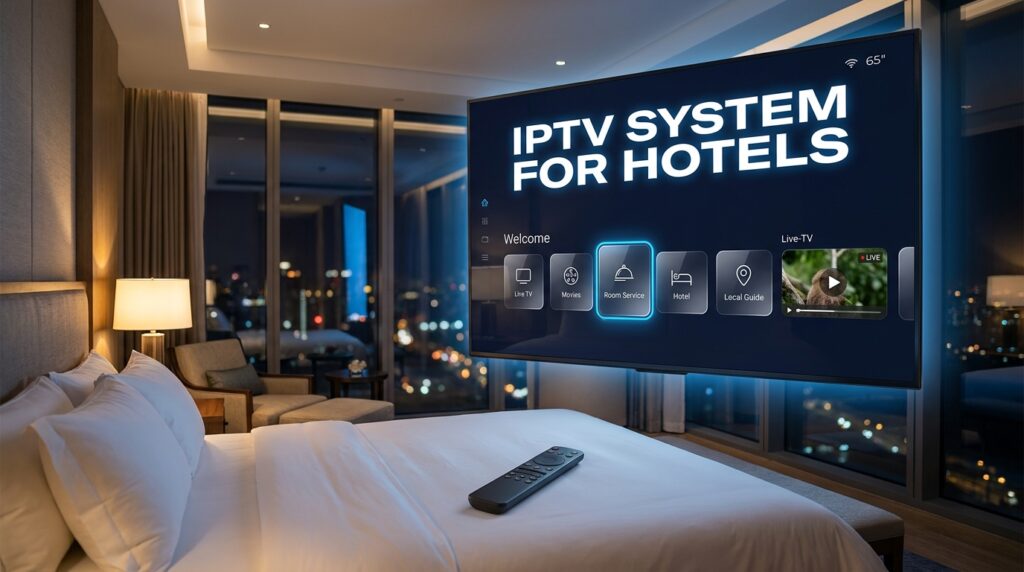
What Is an IPTV System for Hotels?
An IPTV system for hotels delivers television and interactive content to guest rooms over the property’s internet network instead of coaxial cable. The Wikipedia entry on Internet Protocol Television covers the underlying technology.
Unlike a home setup, a hotel system is built for centralized, multi-room management. A typical IPTV system for hotels provides:
- Live TV and on-demand content to every room
- A branded welcome screen and interactive menu
- Centralized control from a single dashboard
- Integration with hotel services and information
This turns the in-room TV from a basic cable box into a guest-facing platform. The rest of this guide covers why that matters commercially and what to look for.
Why Hotels Are Switching to IPTV
This deserves the first substantive section, because the business case drives the decision.
Hotels are moving from traditional cable to an IPTV system for hotels for reasons that go beyond picture quality. The shift is commercial as much as technical.
The core drivers:
- Guest expectations: travelers expect home-quality streaming
- Cost efficiency: lower long-term costs than cable contracts
- Centralized control: manage every room from one place
- Branding and revenue: in-room marketing and upselling
Why cable is fading in hospitality:
- Rigid channel packages guests do not want
- No on-demand or interactive features
- Per-room cabling that is costly to maintain
- No branding or upsell opportunity
An IPTV system for hotels addresses each of these. It meets modern guest expectations while giving operators control and commercial upside cable never offered. Explore what modern streaming looks like on our full channels list.
Benefit One: A Better Guest Experience
The first benefit is the one guests notice immediately.
An IPTV system for hotels transforms the in-room experience from dated cable to a modern, familiar interface. Guests get what they have at home.
What guests gain:
- On-demand movies and shows, not just live channels
- A clean, intuitive interface like their own devices
- The ability to cast or access their own accounts, where supported
- Multi-language menus for international travelers
Why this matters for the hotel:
- Guest satisfaction scores rise with better amenities
- A modern room feels more premium
- Positive reviews mention the little things
- Returning guests remember a good experience
In a competitive market, the in-room experience is a differentiator. An IPTV system for hotels turns a commodity, the TV, into a point of satisfaction. See how a premium interface feels on our pricing overview.
Benefit Two: Lower Long-Term Costs
The second benefit is the one that convinces finance.
While an IPTV system for hotels requires upfront investment, it typically costs less over time than traditional cable, especially at scale.
Where the savings come from:
- No recurring per-room cable subscription fees
- Uses the existing internet network infrastructure
- Centralized management reduces maintenance labor
- Easier, cheaper updates than rewiring
The scale factor:
- The more rooms, the greater the savings
- Cable costs multiply per room, IPTV shares infrastructure
- Long-term total cost favors IPTV at hotel scale
- Maintenance is software-based, not physical
For a property weighing the investment, an IPTV system for hotels is a long-term cost decision, not just a technology upgrade. The math improves with every room. The FCC Broadband Speed Guide helps size the network needed.
Benefit Three: Branding and Revenue
The third benefit is the one cable never offered.
An IPTV system for hotels turns the in-room TV into a marketing and revenue channel, something a cable box simply cannot do.
Branding opportunities:
- A custom welcome screen with the hotel’s identity
- Personalized greetings by guest name
- On-screen information about hotel amenities
- A consistent brand experience in every room
Revenue opportunities:
- Promoting the on-site restaurant, spa, or bar
- Upselling room service and upgrades
- Advertising local partners and tours
- In-room ordering, where integrated
An IPTV system for hotels makes the television work for the business, not just the guest. That combination of branding and upselling is a genuine commercial advantage.
What to Look For in an IPTV System for Hotels
Practical guidance for operators evaluating options.
Not every IPTV system for hotels is equal. When evaluating, prioritize:
- Reliability: guest-facing systems cannot fail
- Centralized management: control all rooms from one dashboard
- Scalability: easy to add rooms as you grow
- Integration: works with your PMS and hotel services
- Support: responsive help for a business-critical system
- Content licensing: properly licensed for commercial use
The licensing point is critical:
- Hotels need commercially licensed content
- Consumer services are not licensed for hotel use
- Proper commercial licensing avoids legal risk
- This is non-negotiable for a legitimate business
For any IPTV system for hotels, commercial licensing is essential, and the U.S. Copyright Office sets out how content rights operate. This is where a hotel deployment differs fundamentally from a home setup.
Planning Your Network for IPTV
An IPTV system for hotels depends entirely on the network behind it.
Before deploying, ensure your infrastructure can support it. Per the FCC Broadband Speed Guide:
- HD per room: around 10 Mbps per active stream
- Ultra HD per room: 25 Mbps per active stream
- Peak load: plan for many rooms streaming at once
Network planning essentials:
- Sufficient total bandwidth for peak occupancy
- Robust in-property wiring or Wi-Fi
- Quality-of-service settings prioritizing IPTV
- Headroom for future growth
A guest-facing IPTV system for hotels lives or dies on network capacity. Test and size it properly before deployment. Confirm baseline speeds at Speedtest.net.
Common Deployment Mistakes to Avoid
Learning from others saves costly errors.
When deploying an IPTV system for hotels, avoid these:
- Undersizing the network for peak occupancy
- Skipping commercial licensing to save money
- Choosing on price alone over reliability
- Ignoring PMS integration, missing efficiency gains
- Neglecting support terms, critical for guest-facing tech
Each of these turns a smart investment into an operational headache. An IPTV system for hotels is business-critical, so plan it as carefully as any core system. Broader business guidance appears in the FTC’s advice for small businesses.
Is an IPTV System for Hotels Legal?
A straight answer serves better than reassurance. IPTV technology is fully legal, and hotel deployments are common and legitimate. The key is commercial licensing.
A legitimate IPTV system for hotels uses content licensed for commercial, public-facing use, which differs from a home subscription. This is essential, since hotels show content to paying guests. Work with a provider that handles commercial licensing properly, and the U.S. Copyright Office context explains why this matters.
Signals of a proper hotel solution:
- Commercial content licensing, not consumer
- A system built for multi-room management
- Business-grade reliability and support
- PMS and hotel-service integration
- Scalability for your property size
Who Benefits Most From an IPTV System
Strong fit:
- Hotels wanting to modernize the guest experience
- Properties at scale seeking long-term cost savings
- Operators wanting in-room branding and upsell
- Hotels replacing aging cable infrastructure
Consider carefully if:
- You have very few rooms, where scale savings are smaller
- Your network needs major upgrades first
- Guest TV use is minimal at your property
For most hotels above a certain size, an IPTV system for hotels is a sound investment in experience, efficiency, and revenue.
Frequently Asked Questions About IPTV System for Hotels
What is an IPTV system for hotels?
It delivers live TV, on-demand content, and interactive services to guest rooms over the hotel’s internet network, with centralized control and branding, replacing traditional cable.
Is an IPTV system for hotels cheaper than cable?
Over the long term, usually yes, especially at scale. It avoids per-room cable fees and uses existing network infrastructure, though it requires upfront investment.
Does a hotel IPTV system need special licensing?
Yes. Hotels require commercially licensed content for public-facing use, which differs from a consumer subscription. This is essential for a legitimate deployment.
What network do I need for an IPTV system for hotels?
Enough bandwidth for peak occupancy, roughly 10 Mbps per HD room or 25 Mbps per 4K room streaming at once, plus robust wiring and quality-of-service settings.
Can an IPTV system for hotels generate revenue?
Yes. Through in-room branding, promoting on-site services, upselling, and advertising local partners, the system turns the TV into a marketing and revenue channel.
Closing Assessment
An IPTV system for hotels is more than a television upgrade, it is an investment in guest experience, operational efficiency, and revenue. It meets the streaming expectations modern travelers bring from home, cuts long-term costs versus cable at scale, and turns every in-room TV into a branding and upsell channel that cable never could.
The keys to a successful deployment are planning the network for peak demand, insisting on proper commercial licensing, and choosing a system on reliability and support rather than price alone. Get those right, and an IPTV system for hotels pays back across satisfaction scores, cost savings, and new revenue. It is one of the clearer modernization wins available to a hospitality operator today.
Ready to explore an IPTV solution for your property? Message our team to discuss your hotel’s needs, room count, and network, and we will help you scope the right approach. If this IPTV system for hotels guide helped, share it with another operator.