

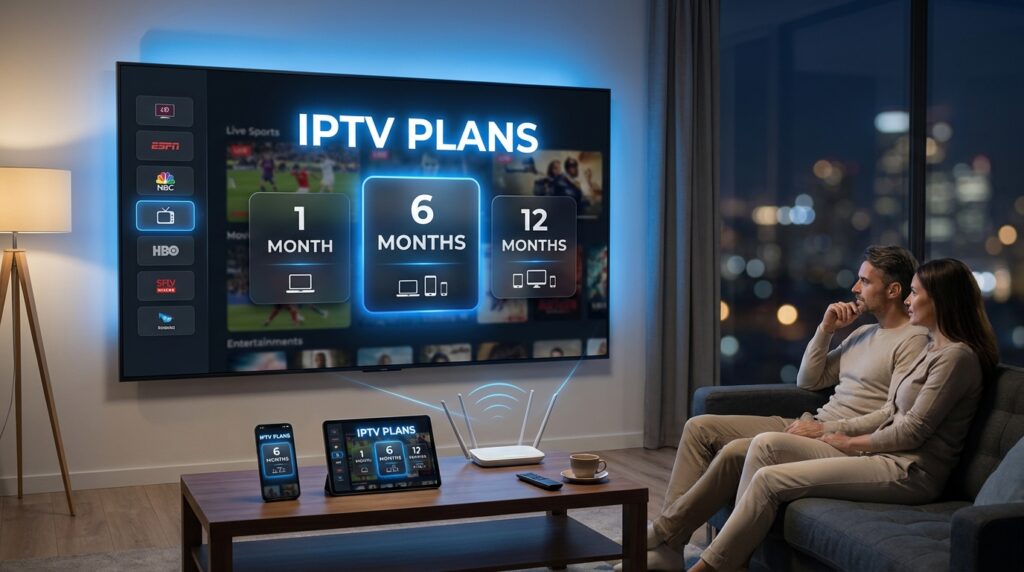
What IPTV Plans Are Actually Built From
An IPTV plan gives you streaming television over your internet connection instead of a cable line or satellite dish. The Wikipedia entry on Internet Protocol Television covers the underlying mechanics.
Here is the part most buyers miss. Nearly every provider builds IPTV plans from just two variables:
- Duration, how long the term runs, from one month to several years
- Connections, how many screens can stream at the same time
The channels and the on-demand library are usually identical across every tier. A higher plan almost never unlocks more content. It unlocks more screens and a lower monthly rate.
Once you see IPTV plans this way, the whole comparison gets simpler. You are not choosing a product. You are choosing two numbers.
Mistake One: Overpaying for Connections You Never Use
This is the first expensive error, and it is more common than you would think.
Providers offer plans supporting one, two, three, or more simultaneous connections. It is tempting to buy the bigger number for safety. For a single viewer or a couple, that is money wasted every month.
Why people overbuy connections:
- The bigger tier feels safer, so they pick it by default
- They confuse connections with quality, assuming more is better
- They plan for a houseful of viewers they do not actually have
- The upsell is designed to make the top tier look reasonable
Connections only matter when people watch different things at the same time. If your household never has two screens running at once, a multi-connection plan is pure waste. Be honest about your real viewing before you pay for capacity you will not touch.
Mistake Two: Underbuying and Fighting for the Screen
The opposite error, and it ruins more evenings than any other.
To save a few dollars, some buyers choose a single-connection plan for a whole family. Then Sunday arrives, one person wants the game, another wants a movie, and only one stream works.
Why underbuying hurts:
- Standard single-connection plans allow only one stream at a time
- A second screen simply will not play until the first stops
- Families discover the limit at the worst possible moment
- The saving was tiny, the frustration is weekly
The fix is simple: count how many people in your home watch at the same time on a busy night, not on average. That number, not the lowest price, is what decides your connection tier. Explore how our tiers map to real households on the IPTV Verse pricing page.
How Many Connections Do You Actually Need?
A quick way to get the connection count right the first time.
Match the plan to your real peak, the busiest moment your household ever hits:
- One connection: a single viewer, or a couple who always watch together
- Two connections: a couple with different tastes, or one parent and one child
- Three connections: a typical family with kids watching separately
- Four or more: larger households, or homes where sports and shows clash often
The key word is peak. Plan for the busiest night, not the quiet average, because the quiet nights were never the problem. This single question prevents both mistakes at once.
Why Longer IPTV Plans Cost Less Per Month
Now the second variable: duration. Longer terms are cheaper monthly, and the reason is pure business, not quality.
What drives the discount:
- Guaranteed revenue lets a provider plan server capacity ahead
- One transaction replaces twelve, cutting processing costs
- Lower churn reduces support and acquisition overhead
- Committed customers are simply cheaper to serve
Typical 2026 pricing across IPTV plans looks like this:
| Plan Length | Rough Monthly Rate | Best For |
|---|---|---|
| Monthly | Highest per month | Testing a service |
| 6 months | Mid-range | Cautious commitment |
| 12 months | Lowest honest rate | Confident long-term use |
So a yearly plan at a low monthly rate is not suspicious. That is the discount working normally. What should worry you is a price far below the honest band, which signals capacity nobody funded.
The Risk Side of Longer Plans
The discount is real, but it is not free, and honesty here protects you.
A long plan means paying upfront for a service you have not lived with yet. In a market where some providers disappear, that carries risk.
How to take the discount without the danger:
- Start with a trial or a short plan to test stability
- Confirm your specific channels work during peak hours
- Check the refund terms in writing before committing
- Only then commit to a longer term for the lower rate
This sequence gives you the yearly discount while removing most of the downside. Verify things first, commit second. Our IPTV Verse setup guide is the easiest place to start testing.
Matching IPTV Plans to Real Households
Let’s make this concrete with three common situations.
The single viewer or couple who watch together: one connection on a yearly plan. Lowest cost, no wasted capacity, no screen conflict because there is only ever one stream in use.
The family with kids: two or three connections, depending on how often screens clash. Start with two, watch for conflicts, and only move up if the fights are frequent.
The sports-and-shows household: at least two connections, because game day is exactly when two screens run at once. Underbuying here guarantees a weekly argument.
Notice that none of these is about the cheapest plan. Each is about the fit. That is the whole skill of choosing IPTV plans well. Compare your own situation on the IPTV Verse channels list.
Are Cheap IPTV Plans Legal and Safe?
A straight answer serves better than reassurance. The technology is fully legal, and paying for a subscription is legal. Legality depends on whether the operator licenses what it distributes.
Price is also a safety signal. When IPTV plans are priced far below the honest band, that raises questions, since real infrastructure costs money. The U.S. Copyright Office sets out how content rights operate.
Signals of trustworthy IPTV plans:
- Transparent pricing within a believable range
- Clear connection counts stated per tier
- A real trial or refund policy
- Your specific channels listed and verifiable
- Responsive support before and after you pay
Review our approach on the IPTV Verse about page and our full terms and conditions before subscribing.
Bandwidth: The Hidden Variable in Any Plan
No plan performs well without a connection to match. Per the FCC Broadband Speed Guide:
- HD streaming: around 10 Mbps per stream
- Ultra HD 4K: 25 Mbps per stream
- Multiple connections: add those figures together
This is the detail multi-connection buyers forget. Three connections need roughly three times the bandwidth. If your internet cannot supply it, the extra connections you paid for will buffer. Confirm your speed at Speedtest.net before choosing a tier.
Four quick fixes solve most plan-related complaints:
- Wire your main television directly
- Keep devices close to the router
- Schedule big downloads outside viewing hours
- Restart your router weekly
The IPTV Plans Decision, in One Minute
Everything above reduces to a short checklist:
- Count your peak viewers, the busiest night, not the average
- Match connections to that number, no higher, no lower
- Pick a term that fits your confidence, monthly to test, yearly to save
- Verify first, then commit to the longer plan for the discount
- Check your bandwidth covers the connections you chose
Run those five steps and you avoid both the overspend trap and the underbuy trap. That is the entire decision.
Who Each Plan Type Fits Best
Short monthly plans fit:
- First-time buyers testing a new service
- Anyone unsure about stability or channel coverage
- Viewers who want zero long-term commitment
Longer yearly plans fit:
- Households already confident in the service
- Viewers wanting the lowest honest monthly rate
- Anyone who has already verified their channels work
The right choice moves with your confidence. Test short, then commit long once you know the service fits.
Frequently Asked Questions About IPTV Plans
How do I choose between IPTV plans?
Decide two things: how many people watch at the same time on a busy night, and how long you want to commit. Those two numbers pick your plan.
Why do longer IPTV plans cost less per month?
Guaranteed revenue and fewer transactions cut a provider’s costs, and that saving is passed on. It reflects business mechanics, not lower quality.
How many connections do I need?
Count your peak simultaneous viewers, not your average. One for a single viewer, two or three for a family, more for larger households.
Are cheap IPTV plans a red flag?
Prices far below the honest band are a warning, since real infrastructure costs money. A believable price with clear terms is safer than the lowest number.
Should I start with a monthly or yearly plan?
Start monthly or with a trial to verify stability and channels, then switch to a yearly plan for the lower rate once you are confident.
Closing Assessment
Choosing between IPTV plans is not about finding the cheapest price or the biggest tier. It is about avoiding two mistakes: paying for connections you never use, and saving a few dollars only to fight over a single screen every week.
Get the two variables right, connections matched to your peak and a term matched to your confidence, and everything else falls into place. Count your real viewers, verify the service on a short plan, then commit long for the discount. Do that, and you will pay for exactly what your household needs, nothing more and nothing less.
Ready to find the plan that fits your home? Start your 24 hour IPTV trial and test your channels and connections before committing, full access, zero risk. Prefer to ask first? Message us on WhatsApp at 212 783-138394 and we will help you pick the right tier. If this IPTV plans guide helped, pass it on.