

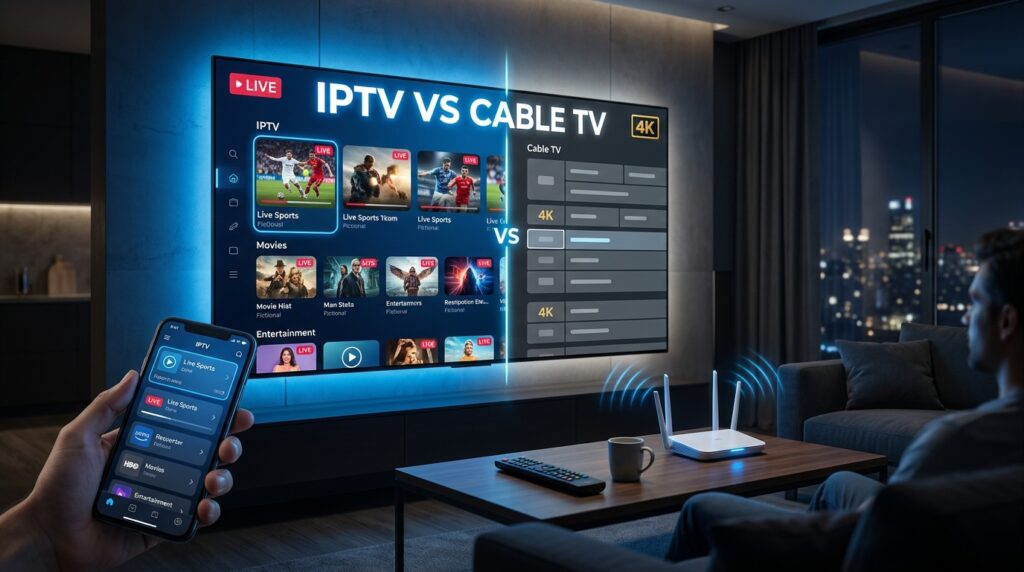
IPTV vs Cable TV: The Core Difference
IPTV delivers television over your internet connection, while cable TV uses a dedicated coaxial line. The Wikipedia entry on Internet Protocol Television covers the technology.
The fundamental IPTV vs Cable TV difference shapes everything else:
- IPTV: channels arrive as data over your internet
- Cable TV: channels arrive over a physical coax line
- IPTV: works on any device, anywhere
- Cable TV: works through a rented box, at home
Why this matters:
- IPTV’s internet delivery enables flexibility and low cost
- Cable’s dedicated line enables guaranteed reliability
- Each strength flows from the delivery method
- The trade-offs are baked into how each works
The rest of this guide compares IPTV vs Cable TV on each specific factor. Compare a modern lineup on our full channels list.
Round One: Cost
This deserves the first substantive section, because cost is where IPTV vs Cable TV is least close.
Cost is IPTV’s most decisive advantage. The gap is enormous.
Cable TV costs:
- Around $100 to $150 monthly once fees are added
- Equipment rental per box, stacking up
- Regional and franchise fees at billing
- Over $1,200 a year for a typical package
IPTV costs:
- Roughly $10 to $20 monthly for a full service
- No equipment rental, using devices you own
- No hidden regional fees
- A fraction of cable’s annual cost
The IPTV vs Cable TV verdict on cost:
- IPTV wins decisively, saving over $1,000 a year
- The savings alone drive most switches
- No contest on pure price
For cost, IPTV vs Cable TV is not close. IPTV wins by a wide, consistent margin. See believable pricing on the pricing page.
Round Two: Channels and Content
The second round also favors IPTV clearly.
Content breadth is another strong IPTV advantage in the IPTV vs Cable TV comparison.
| Factor | IPTV | Cable TV |
|---|---|---|
| Live channels | Very large | Package-limited |
| On-demand | Huge library | Limited |
| International | Extensive | Few, extra cost |
Where IPTV wins on content:
- Far more live channels than any cable package
- Vast on-demand libraries included
- Extensive international channels
- Sports from global leagues
Where cable holds ground:
- Guaranteed regulated local channels
- No dependence on internet for delivery
For channels and content, IPTV vs Cable TV again favors IPTV, offering more variety in one subscription than cable packages provide. Explore the range on our 24 hour trial.
Round Three: Flexibility
The third round is a clean IPTV win.
Flexibility is where the IPTV vs Cable TV gap is starkest in daily use.
IPTV flexibility:
- Watch on any device: TV, phone, tablet, computer
- Take your subscription anywhere with internet
- No box tying you to one room
- Multiple screens on higher plans
Cable TV limitations:
- Tied to a rented box per television
- Fixed to your home address
- No portability when traveling
- Extra boxes cost extra
The IPTV vs Cable TV verdict on flexibility:
- IPTV wins decisively
- Portability and multi-device are built in
- Cable’s fixed model cannot compete here
For flexibility, IPTV vs Cable TV is another clear IPTV victory. Your subscription follows you; cable stays home.
Round Four: Reliability
The fourth round is where cable finally wins.
Reliability is cable TV’s genuine advantage in the IPTV vs Cable TV comparison, and it is a real one.
Cable TV reliability:
- Does not depend on your internet quality
- Consistent delivery over a dedicated line
- No buffering from network congestion
- Regulated service standards
IPTV reliability:
- Depends entirely on your internet connection
- Can buffer on a weak or congested connection
- Quality varies with your bandwidth
- Peak-hour congestion can affect streams
The IPTV vs Cable TV verdict on reliability:
- Cable wins for guaranteed consistency
- IPTV matches it only with solid broadband
- This is cable’s strongest card
For reliability, cable TV takes the round, provided you value guaranteed consistency over everything else. With good internet, though, IPTV closes the gap. Per the FCC Broadband Speed Guide, 25 Mbps per 4K stream keeps IPTV smooth.
Round Five: Contracts and Commitment
The fifth round swings back to IPTV.
Commitment is another clear IPTV advantage in the IPTV vs Cable TV decision.
Cable TV contracts:
- Often lock you into 1 to 2 year terms
- Early cancellation fees
- Price hikes after promotional periods
- Difficult cancellation processes
IPTV commitment:
- No long-term contracts typically
- Cancel or switch anytime
- Pay month to month if preferred
- No cancellation penalties
The IPTV vs Cable TV verdict on contracts:
- IPTV wins for freedom and flexibility
- No lock-in, no penalties
- Cable’s contracts are a common frustration
For contracts, IPTV vs Cable TV favors IPTV, which keeps you free rather than locked in.
The Overall Scorecard
Tallying the IPTV vs Cable TV rounds.
| Round | Winner |
|---|---|
| Cost | IPTV |
| Content | IPTV |
| Flexibility | IPTV |
| Reliability | Cable TV |
| Contracts | IPTV |
IPTV wins four of five rounds in the IPTV vs Cable TV comparison, losing only on guaranteed reliability. For most households with solid broadband, that makes IPTV the clear overall choice.
Is IPTV Legal and Safe vs Cable?
A straight answer serves better than reassurance. Both IPTV and cable are legal. For IPTV, legality depends on whether the provider licenses its content, while cable is licensed by definition.
Choosing a transparent IPTV provider is what keeps the IPTV vs Cable TV choice safe, and the U.S. Copyright Office sets out how content rights operate.
Signals of a trustworthy IPTV service:
- A trial to test before paying
- Verifiable channels by name
- Clear pricing within a believable band
- Responsive support
- A refund policy
Review our approach on the IPTV Verse about page and our full terms and conditions.
Bandwidth: The Deciding Factor
In the IPTV vs Cable TV choice, your internet decides whether IPTV can match cable’s reliability. Per the FCC Broadband Speed Guide:
- HD streaming: around 10 Mbps per stream
- Ultra HD 4K: 25 Mbps per stream
- Multiple connections: add those figures together
With solid broadband, IPTV closes its one weakness against cable. Confirm your speed at Speedtest.net before deciding.
Four quick fixes to strengthen IPTV’s reliability:
- Wire your main television directly
- Keep devices close to the router
- Schedule big downloads outside viewing hours
- Restart your router weekly
Who Should Choose IPTV Over Cable
Choose IPTV if you:
- Want to cut your TV bill dramatically
- Have solid, reliable broadband
- Value flexibility and portability
- Want more channels and on-demand content
- Dislike contracts and lock-in
Cable TV may suit you if you:
- Have unreliable or slow internet
- Value guaranteed reliability above all
- Need regulated local channels specifically
- Prefer a traditional, hands-off setup
For most modern households, the IPTV vs Cable TV decision favors IPTV, with cable reserved for those prioritizing guaranteed reliability.
Frequently Asked Questions About IPTV vs Cable TV
Is IPTV cheaper than cable TV?
Yes, dramatically. IPTV runs roughly $10 to $20 monthly against cable’s $100 to $150 with fees, saving over $1,000 a year. Cost is IPTV’s biggest advantage.
Is IPTV better than cable TV?
For most households with solid broadband, yes. IPTV wins on cost, content, flexibility, and contracts. Cable only wins on guaranteed reliability independent of your internet.
Does IPTV vs Cable TV depend on my internet?
Yes. IPTV’s quality depends entirely on your connection, while cable does not. With good broadband, IPTV matches cable; with weak internet, cable is more reliable.
Can IPTV replace cable TV completely?
For most viewers, yes. It offers more channels and on-demand content at a fraction of the cost. The main consideration is having a reliable internet connection.
What does cable TV do better than IPTV?
Guaranteed reliability independent of your internet, and regulated local channels. These are cable’s genuine advantages in the IPTV vs Cable TV comparison.
Closing Assessment
The IPTV vs Cable TV comparison is more one-sided than cable providers would like to admit. IPTV wins on cost by over a thousand dollars a year, on content with far more channels and on-demand, on flexibility with any-device portability, and on contracts with no lock-in. Cable wins exactly one round: guaranteed reliability that does not depend on your internet.
That single cable advantage matters only if your broadband is weak. For the growing majority of households with solid internet, IPTV wins four of five rounds and the overall decision comfortably. Weigh your own connection honestly, and if it is reliable, the IPTV vs Cable TV choice is clear. Test IPTV with a trial, and you will likely wonder why you paid cable prices for so long.
Ready to see how IPTV compares for you? Start your 24 hour IPTV trial and test it against your cable before cancelling anything, full access, zero risk. Prefer to ask first? Message us on WhatsApp at 212 783-138394 and time the reply yourself. If this IPTV vs Cable TV guide helped, pass it on.