

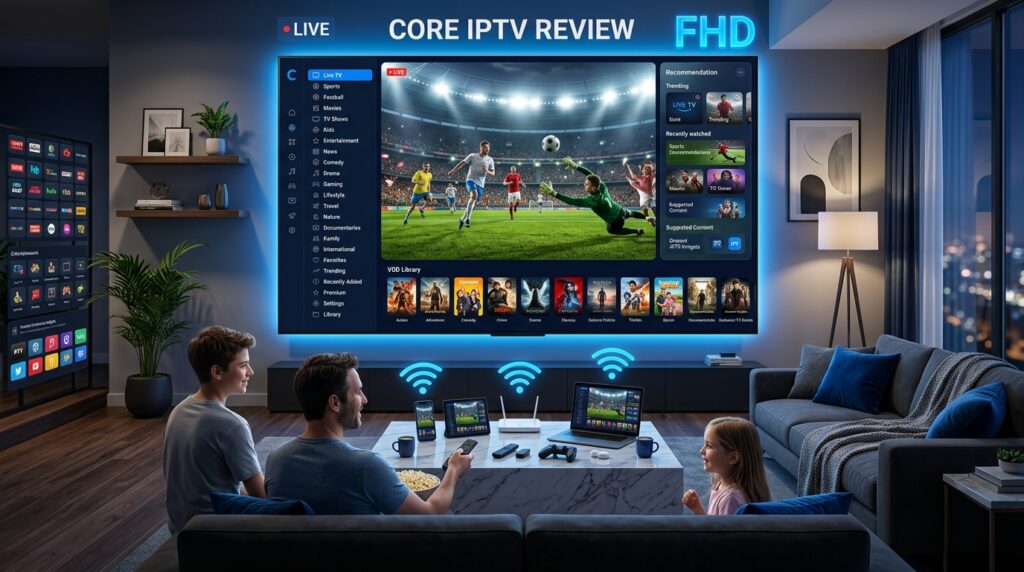
What Core IPTV Offers
Core IPTV distributes television across your internet connection instead of a coaxial line or dish. The Wikipedia entry on Internet Protocol Television walks through the underlying architecture if the mechanics interest you.
The service runs a straightforward storefront model, listing plans by duration and connection count. Its natural audience skews toward:
- Viewers comparing options primarily on monthly cost
- Households needing two or more concurrent connections
- People wanting a large film and series catalogue alongside live channels
- Users who prefer buying through a conventional checkout rather than messaging a seller
That last point is worth noting. Purchasing through a proper storefront rather than a chat conversation is a small structural advantage over many competitors.
Core IPTV Channels and Library
The published lineup covers the expected ground:
- Roughly 16,000 live channels across regions
- Approximately 35,000 films, series and shows on demand
- FHD, HD and SD tiers, with premium categories included
- Support across common devices and applications
- Anti-freeze handling and free content updates
Notably absent from the headline specs is 4K. Where rivals lead with Ultra HD claims, Core IPTV lists FHD as its ceiling, which is either refreshing honesty or a genuine limitation depending on your screen. Either way, verify it during a trial if resolution matters.
Compare that against our openly published full IPTV channels list, which itemises exactly what sits behind each region.
The 98% Uptime Figure Deserves Attention
This is the section that matters most in any Core IPTV review, and almost nobody discusses it properly.
Core IPTV publishes 98% uptime in its product descriptions. Competitors routinely advertise 99.9% or even a flat 100%. On the surface, 98% sounds close enough. Run the arithmetic and it separates sharply.
What 98% actually permits across a month:
- Roughly 14.4 hours of downtime
- Spread unevenly, since outages cluster around demand peaks
- Potentially several evening interruptions across a billing cycle
Compared with 99.9%:
- Roughly 43 minutes of monthly downtime
- A twentyfold difference in permitted interruption
Now, a provider publishing 98% is arguably being more truthful than one claiming 100%, since perfect uptime does not exist. But truthfulness about a modest figure is still a modest figure. Fourteen hours of monthly downtime, concentrated on the evenings when servers strain hardest, is not a trivial allowance.
Read that number as a commitment rather than a boast, and judge accordingly.
Streaming Quality Expectations
Setting realistic expectations matters more here than with premium-positioned rivals.
- Resolution ceiling is published as FHD rather than Ultra HD
- Anti-freeze handling is advertised across all plan tiers
- Peak periods remain the honest test given the stated uptime allowance
- Independent long-term testing is thin, so trial verification carries extra weight
- Application compatibility is broad, which helps if your preferred player is picky
If your television is 1080p and you mostly watch entertainment rather than fast-motion sport, the ceiling may not bother you at all. On a large Ultra HD panel, it will.
Is Core IPTV Legal and Safe?
An honest answer serves you better than reassurance. The technology is entirely lawful. Legality depends on content licensing, which is where nearly every service in this bracket becomes opaque.
Core IPTV, like the majority of comparable providers, publishes minimal verifiable licensing detail. When thousands of premium channels stream for under twenty dollars monthly, the arithmetic invites questions, because licensing at that scale costs considerably more. Unlicensed streaming is unlawful across the United States and most jurisdictions, and the U.S. Copyright Office sets out how content rights operate.
Practical precautions regardless of which provider you choose:
- Confirm which specific domain processes your payment
- Prefer payment routes that permit disputes
- Keep credentials out of shared or public spaces
- Download player applications from official sources only
- Retain purchase correspondence in case questions arise later
Core IPTV Pricing Structure
Pricing follows a discount-storefront pattern, with listed prices frequently marked down.
Reported figures include:
- Single connection plans listed near $25, discounted to around $17.50
- Two connection plans listed near $40, discounted to around $28
- Longer durations reducing the effective monthly figure further
- A free trial listed at zero cost through the same storefront
Permanent discounting is common in this market and worth recognising for what it is: the discounted figure is the actual price, and the crossed-out number exists to make it feel like a bargain. That is standard retail practice rather than deception, but it means comparing headline prices across providers requires reading the actual charge.
Our pricing page lists one figure per plan without the theatre.
Bandwidth Requirements
Delivery quality tracks your connection regardless of provider. The FCC Broadband Speed Guide sets the benchmarks:
- Standard definition: around 5 Mbps
- High definition and FHD: around 10 Mbps
- Ultra HD: 25 Mbps per concurrent stream
Since Core IPTV tops out at FHD, your bandwidth requirements sit at the lower end, which is a genuine practical benefit for households on modest connections.
Confirm your actual throughput at Speedtest.net before attributing any problem to a provider.
Four adjustments that resolve the majority of playback complaints:
- Cable your primary television directly to the router
- Shorten the distance between router and streaming device
- Defer large downloads until outside viewing hours
- Cycle the router weekly
Core IPTV Strengths and Weaknesses
Fair assessment means both columns.
Genuine strengths:
- Conventional storefront checkout rather than chat-based sales
- Substantial on-demand catalogue at roughly 35,000 titles
- Multi-connection plans available at reasonable increments
- Free trial listed openly rather than requiring negotiation
- Published uptime figure, however modest, indicates some candour
Genuine weaknesses:
- FHD ceiling with no advertised Ultra HD
- 98% uptime permits roughly 14 hours of monthly downtime
- Limited independent long-term testing available
- Minimal verifiable licensing information
- Permanent discount pricing obscures true comparison
The pattern is a service positioned honestly at the practical end of the market, without premium ambitions and without pretending otherwise.
How Core IPTV Compares Structurally
The meaningful distinction between providers rarely comes down to channel totals. It comes down to what they commit to and how they behave when things break.
| Dimension | Modest-Tier Service | Premium-Tier Service |
|---|---|---|
| Published uptime | 98% or unstated | 99.9% with infrastructure behind it |
| Resolution ceiling | FHD | Genuine Ultra HD |
| Peak-hour behaviour | Downtime allowance built in | Load balancing designed for spikes |
| Support responsiveness | Standard | Minutes, not days |
| Pricing presentation | Permanent discounts | One published figure |
Neither column is inherently wrong. What matters is knowing which one you are buying into before the first big match rather than during it.
Device Support
Core IPTV states compatibility with the usual range:
- Amazon Fire TV devices
- Android phones, tablets and TV boxes
- Smart televisions from major manufacturers
- Apple devices
- Desktop and laptop computers
- Common IPTV player applications
Setup follows the standard pattern of installing a player, entering supplied credentials, and allowing the guide to populate. Nothing unusual, which is generally a good sign.
Who Fits Core IPTV Well
Some households will find this a sensible choice:
- 1080p television owners for whom the FHD ceiling is irrelevant
- Catalogue watchers more interested in the film library than live sport
- Two-screen households needing modest concurrency
- Storefront buyers who prefer checkout over chat negotiation
Some will not:
- Ultra HD panel owners wanting resolution matching their screen
- Live sport followers for whom evening downtime is unacceptable
- Large households needing four or more simultaneous streams
A Practical Evaluation Method
Applicable to Core IPTV or any alternative:
- Read the published uptime figure. If it is absent, ask. If it is 98%, calculate what that permits.
- Establish the resolution ceiling before assuming Ultra HD availability.
- Trial during an actual peak event, not a quiet weekday.
- Locate your specific channels, not the promotional selection.
- Contact support pre-purchase and note both speed and usefulness of the reply.
- Confirm refund terms in writing before any payment clears.
Six steps, one evening, and considerably more insight than any ranked list provides. Additional protective context is available through the FTC’s guidance on avoiding online scams.
Frequently Asked Questions
Does Core IPTV offer 4K?
Published specifications list FHD, HD and SD without advertising Ultra HD. Verify during a trial if resolution is a priority for you.
What does the 98% uptime figure mean practically?
Approximately 14 hours of permitted downtime monthly, likely concentrated during high-demand evening periods.
How much does Core IPTV cost?
Listed plans appear near $25 and $40 with standing discounts bringing them to roughly $17.50 and $28 respectively.
Is there a free trial?
A trial is listed at zero cost through the storefront, which is more accessible than services requiring negotiation.
What is the alternative for Ultra HD viewers?
A provider publishing genuine 4K availability alongside a stronger uptime commitment and verified peak-hour infrastructure.
Closing Assessment
Core IPTV occupies a position it appears comfortable with: practical, moderately priced, FHD-capped, and publishing an uptime figure most competitors would bury. That last detail earns some credit, since candour about a modest number beats fiction about a perfect one.
Whether it suits you reduces to two questions. Does an FHD ceiling matter on your television? And does roughly fourteen hours of permitted monthly downtime, likely landing during evenings, sit comfortably with how you watch?
If both answers are no, it may serve you fine. If either is yes, the gap between this tier and a premium one is exactly where your money should go.
Want to compare against a service that publishes 4K availability and a stronger reliability commitment? Start your 24 hour IPTV trial and evaluate both on your own screen tonight. Questions beforehand? Message our team and time the response yourself. If this Core IPTV review clarified things, pass it along to someone else comparing options.